
 प्रदेश-१
 मधेस
मधेस बागमती
 गण्डकी
 लुम्बिनी
 कर्णाली
 सुदूरपश्चिम
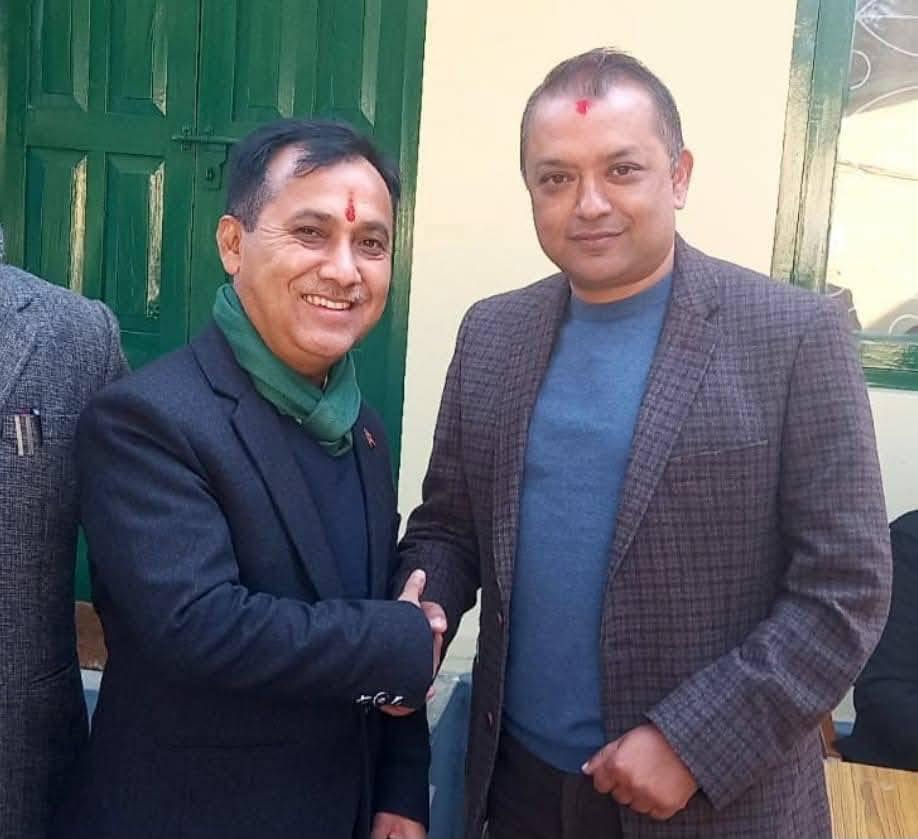
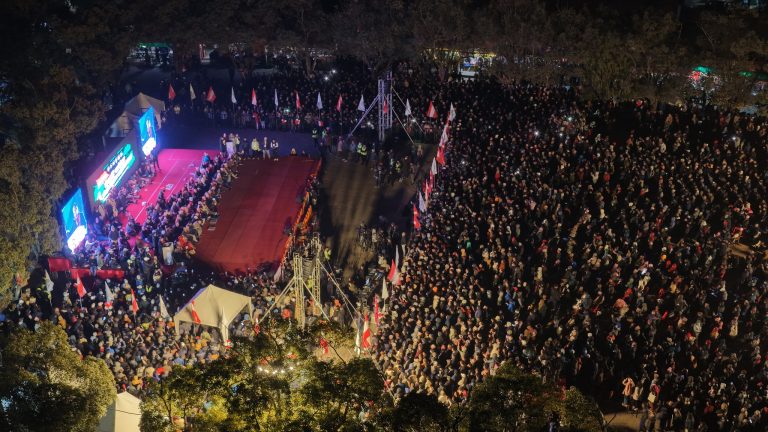
Kathmandu, 12 January – This day is likely to be remembered in the history of the Nepali Congress as one of the most divisive and decisive moments. On one side, thousands of General Convention representatives gathered at Bhrikuti Mandap with tremendous enthusiasm and energy; on the other side, long discussions and visible confusion continued throughout the day at President Sher Bahadur Deuba’s residence in Maharajgunj. This contrast has clearly exposed the deep internal conflict within the party.
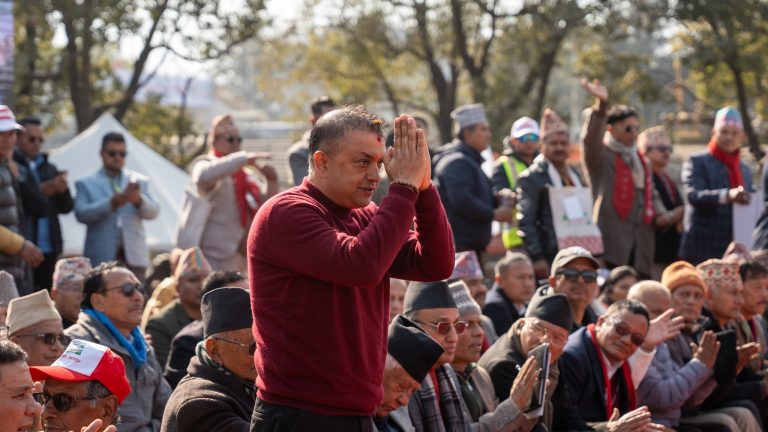
The Atmosphere at Bhrikuti Mandap and the Leadership of Gagan–Bishwa
From early morning, crowds of representatives poured into Bhrikuti Mandap. By 6:25 p.m., when General Secretary Gagan Thapa stepped onto the stage, the hall was packed to capacity. The moment the program host announced his name, the hall erupted with thunderous applause and loud slogans. As soon as he began speaking, the crowd fell into complete silence and rapt attention. Gagan’s speech mesmerized everyone present.
Special Presence for a Special Occasion!
“I have never seen such a long political program where people remained seated without any disturbance,” he said. “This is not just a special name; we must make it truly special and bring it to a meaningful conclusion.”
He openly stated: “We wanted to see the party president inaugurate the event, and we also wished the acting president to be present here.” This single sentence not only revealed dissatisfaction with the establishment faction but also highlighted the growing emotional distance within the party.
According to the organizers, 2,662 representatives have signed their attendance – a clear majority of the total delegates. Prominent leaders including former Vice-President Gopalman Shrestha, Chandra Bhandari, Mahesh Acharya, Narahari Acharya, Pushpa Bhusal, Binod Chaudhary, Sunil Sharma, Uday Shamsher Jhapa, Kedar Karki, Taranath Ranabhat, and dozens of other influential figures were visibly present at Bhrikuti Mandap. This massive turnout demonstrates that even the establishment faction’s circulars and pressure could not stop grassroots workers and mid-level leaders.
Meanwhile, at Deuba’s residence, Acting President Purna Bahadur Khadka and other close aides held discussions throughout the day. Central Committee member Ramesh Lekhak said, “The President’s only concern is to save the party at any cost.”
The Deuba camp remains unclear about the ultimate goal of the Gagan–Bishwa group. They initially viewed the gathering as a routine bargaining attempt. They underestimated the resentment over the proportional list and National Assembly candidacy selections, as well as the lingering anger from the Gen-Z movement.
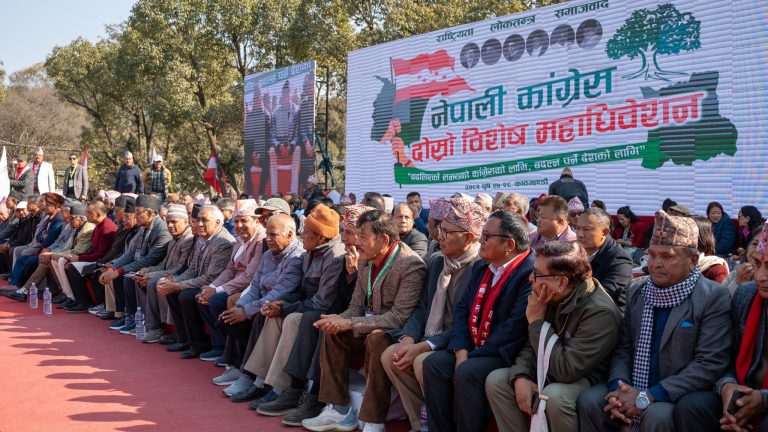
Spokesperson Prakash Sharan Mahat remarked: “The number of delegates they claimed has not actually shown up. We are closely watching which direction this special convention will take.” He expressed confidence that the regular General Convention (scheduled for April) will proceed as planned and that supporters of the special convention will eventually return to it.
Three Different Views on Leadership Change
During the opening session, no clear consensus emerged on the issue of leadership change.
- First view – Gagan Thapa and several speakers asserted that the special convention has the authority to elect both policy and leadership.
- Second view – General Secretary Bishwa Prakash Sharma did not raise the leadership change issue at all; instead, he focused on public discontent and good governance.
- Third view – The majority of delegates and several leaders viewed the special convention as a preparatory platform for the April regular convention and a stage for unity, arguing that leadership change should be left to the regular General Convention.
Leader Guru Raj Ghimire stated: “If the Central Committee takes ownership, the agenda will be set through consensus. Otherwise, the hall itself will decide – on policy, structure, a review of the past 34 years, and leadership.”
56.12% Delegate Participation: Highest from Madhesh Province
A total of 2,662 General Convention representatives have registered for the second special convention, which amounts to 56.12% of the total 4,743 delegates.
When the demand for a special convention was first raised on 29 Ashoj, 54% signatures had been collected. On the very first day of the opening, the number increased by another 2%. According to Publicity Committee Coordinator Subash Pokharel, the figure may rise further before the closed session begins.
The secretariat has announced that fresh registration will resume from 8 a.m. tomorrow (Monday).
Province-wise Participation (based on Sunday’s registration):
- Madhesh Province: 446 (highest)
- Bagmati Province: 432
- Koshi Province: 425
- Lumbini Province: 398
- Gandaki Province: 296
- Kathmandu Valley: 178
- Sudurpaschim Province: 158
- Karnali Province: 134
- Fraternal, well-wishers, and public relations committees: 195
Total registered: 2,662
This level of participation clearly shows that the demand for a special convention is no longer confined to the grassroots level but has spread across provinces. Particularly large numbers of delegates from Madhesh, Bagmati, and Koshi provinces reached Bhrikuti Mandap, clearly reflecting the depth of dissatisfaction and desire for change within the party.
Despite the establishment faction’s directive not to attend the special convention, the presence of a majority of delegates sends a strong signal about how deep the internal pressure has become.
Possibilities Ahead
The special convention has not declared a party split. General Secretary Sharma said: “If a situation of division arises, I will be the first to walk out of this hall.”
However, this gathering has delivered two powerful messages:
- The demand for leadership change at the grassroots and mid-level can no longer be suppressed.
- The establishment faction can no longer ignore the voice of the majority of delegates.
Whatever decision the hall takes in the closed session will determine the future course of the Nepali Congress. Whether it will be party unity, policy change, or the beginning of a new leadership era – the special convention is attempting to settle at least one, if not all, of these issues.
Yet the confusion at Maharajgunj persists. The future of the Nepali Congress now depends not only on the decision of the hall, but also on the final negotiation and understanding between Deuba and Gagan.

प्रतिक्रिया