
 प्रदेश-१
 मधेस
मधेस बागमती
 गण्डकी
 लुम्बिनी
 कर्णाली
 सुदूरपश्चिम
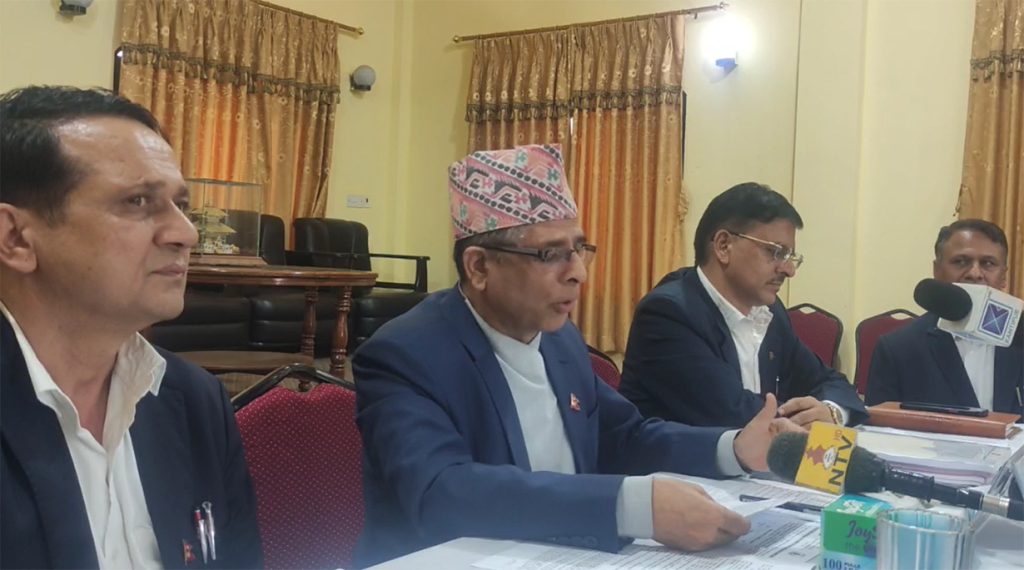
Kathmandu: Tuesday, the Chairman of the National Examination Board, Mahashram Sharma, made claims that there has been improvement in the results as compared to the previous year when the Grade 12 results were made public.
From the 26th of Baisakh to the 5th of Jestha, regular students totaling 372,637, partial examinees totaling 60,959, students elevated to higher grades totaling 14,135, and those advanced due to the grade upgrade in the year 2072/73, totaling 1,106,106 participated in the conducted exams.
Among them, 189,711 are regular, 18,230 are partial examinees, 6140 are elevated to higher grades, and 650 are graded for the year 2072/73 (eligible for higher-level studies). Also, 56 students’ exams were canceled.
According to the Letter Grading Guidelines issued last year, if a subject receives less than 35% marks, it will be marked as Not Graded (NG). Even if students do not fail in the grading system, those with NG marks cannot pursue higher-level studies. They must participate in the Grade Improvement Examination.
As per the Chairman of the National Examination Board, after 80 days of the examination, when the results are made public, 50.91% of the students have passed. He mentioned, “We consider improvement from the previous year.” This year, 182,926 (49.09%) students received NG, whereas there were 188,410 students with NG last year.
Due to this, despite the improvements claimed by the Board, the number of students unable to pursue higher education is significantly high. This has a direct impact on the number of students entering universities.
Educationist Dr. Vidyanath Koirala does not find the claim of improvement in the results credible. He said, “It’s alarming that almost half of the students among the examinees cannot pursue higher education.”
He also pointed out that some students who passed might have received only marginal scores. He emphasized that publicizing accurate data and working on improvements based on it is essential. “Among those who have passed by viewing the results, even if 50% have passed, those who haven’t reached the level of their education are not very far from that,” he mentioned.
According to the Examination Control Office (Grade 12), this year, in the English subject, 109,527 students received NG, the highest number among all subjects. In the Accountancy subject, 52,773 students, and in the Social Studies subject, 51,104 students received NG.
The Chairman of the National Examination Board, Sharma, stated, “The correlation of main classroom learning with students’ results is a matter of utmost concern.”
To address the issue of students failing in up to two subjects, the Grade Improvement Examination will be held on the 6th and 7th of Ashoj, Nepali month. Around 123,396 students will participate. Out of the board members, the number of students who have received NG in only one subject, as stated by Secretary Durga Aryal, is 79,584.
This Year’s Result
According to the public results announced on Tuesday, this year, out of a total of 372,637 examinees, 6,976 individuals will achieve a GPA (Grade Point Average) ranging from 3.61 to 4.00. For those achieving GPA from 3.21 to 3.60, the count is 38,999, for GPA 2.81 to 3.20, it’s 69,174, for GPA 2.40 to 2.80, it’s 63,777, and for GPA 2.01 to 2.40, it’s 11,438. In the range of 1.61 to 2.00, 47 individuals fall.
The Chairman, Sharma, stated that the number and percentage of students attaining higher grades have increased compared to the previous year, while the percentage of those achieving lower grades has decreased. He suggested that this can be seen as an improvement in the results.
In previous years, when only two subjects received NG (Not Graded), only those subjects required the Grade Improvement Examination. If more than two subjects received NG, then exams for all subjects were required to be retaken. However, starting from this year, if more than a certain number of subjects receive NG, only those subjects will require retaking the exams.
In the event of dissatisfaction with the results, the board has announced that students can request a reevaluation within 15 days by paying a fee of 500 rupees per subject. Secretary Aryal also informed that students who are not content with the reevaluation results can even view the answer sheet and further request a reexamination.
For the reexamination, instead of relying on the initial examiners, three new examiners will be appointed to review the paper and calculate the average of their marks. If the obtained score is 10% lower or higher than the original score, the original marks will be considered. If it’s more than 10% different, the new score will be established.

प्रतिक्रिया