 प्रदेश-१
 मधेस
मधेस बागमती
 गण्डकी
 लुम्बिनी
 कर्णाली
 सुदूरपश्चिम
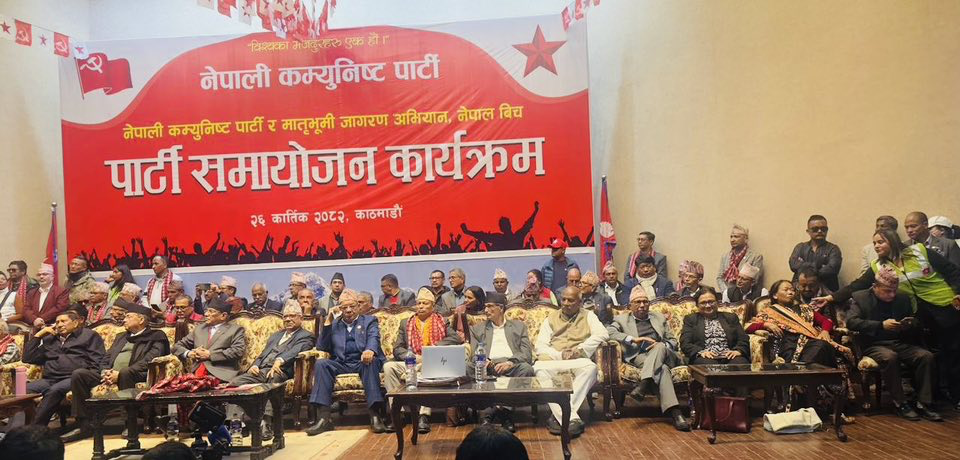
How much power does the newly formed Nepali Communist Party have?
Kathmandu. At the party unification declaration ceremony on the 19th, Coordinator Prachanda had said – “No one can stop us from becoming the number one party. Now we have become number one.”
On Wednesday, leader Bhim Rawal, who had been expelled from Nepal Communist Party (UML) and was running the Motherland Awakening Campaign, also joined the Nepali Communist Party formed by the merger of ten left-wing components. According to leaders, Rawal’s integration has further strengthened the party.
Along with Rawal, Pramod Narayan Yadav, General Secretary of Nepal Communist Party (Shramjivi), has also been absorbed into the NCP. With this, leaders claim that 12 left-wing components have now united in one place.
But how did Prachanda gain such confidence that it would become the first party? This can be calculated from the arithmetic of past elections. However, there is no certainty that the upcoming election will turn out the same.
In 2079 BS (2022-23), three elections were held: for the House of Representatives, provincial assemblies, and local levels. The parties that have now merged also participated in those elections. The Maoist Centre and Unified Socialist had also formed an electoral alliance, which included the Nepali Congress. Due to the alliance, votes were consumed among each other.
How many elected representatives did those parties that fought the election in alliance win? The answer can be found from the election results.
If the components affiliated with the Nepali Communist Party are added up, the party now has 27 members in the National Assembly. The impact of this unity is most visible in the National Assembly. In the 59-member National Assembly, the party is close to a single majority. The NCP (Maoist Centre) has 18 members, NCP (Unified Socialist) has 8, and Bamdev Gautam, nominated by the President, is also in this party.
If we look at the dissolved House of Representatives, Maoist and Unified Socialist together had 42 MPs. However, Kisan Shrestha from the dissolved House did not join this side and went to UML. In provincial assemblies, there are 106 MPs. At the local level, out of 753 municipalities, NCP representatives lead in 144 municipalities.
How many in direct elections?
In the 2079 elections, out of 165 directly elected seats in the House of Representatives, Maoist Centre won 18 and Unified Socialist won 10.
Similarly, out of 330 directly elected provincial assembly members across seven provinces, 68 belong to NCP – 52 from Maoist Centre and 15 from Unified Socialist.
In the last local elections, Maoist Centre won 25 mayor posts and Unified Socialist won 12. For municipality chairperson: Maoist Centre 96, Unified Socialist 11. For deputy mayor: Maoist Centre 33, Unified Socialist 11. For rural municipality vice-chair: Maoist 95, Unified Socialist 12. For ward chairperson: 1,053 from Maoist and 268 from Unified Socialist.
How many in proportional representation?
The Nepal Socialist Party, which participated in the unity, contested under the Maoist’s election symbol (hammer and sickle inside a circle) and received 11,75,684 votes nationwide, securing 14 seats in the House of Representatives. Unified Socialist received 2,98,391 votes but failed to cross the 3% threshold, so no MPs were elected from that vote share.
Across seven provinces, Maoist received 17,63,045 votes for provincial assemblies, from which 38 MPs were elected.
NCP leaders repeatedly say that since Maoist Centre (which has contested multiple elections) and Unified Socialist (formed after the split from UML) are now joined by Bhim Rawal’s Motherland Awakening Campaign, Mahendra Ray Yadav’s Nepal Janata Socialist Party, Subash Raj Kafle’s Janasamajwadi Party, Raju Karki’s NCP (Socialist), Chiran Pun’s Nepal Communist Party, Prem Bahadur Singh’s NCP (Samyawadi), and Karnajit Budhathoki’s NCP (Maoist Socialist), the result of the upcoming election will be in their favour.
But the other side cannot be forgotten either. In the 2079 elections, several leaders who played important roles in Maoist Centre and Unified Socialist have not been able to fit into the newly formed NCP.
For example, from Maoist: Janardan Sharma, Ram Karki, Sudan Kirati, Ganesh Shah and others have left; from Unified Socialist: Ghanshyam Bhusal, Ghanendra Basnet, Ramkumari Jhakri, Kisan Shrestha, Prem Ale and others did not want to join the party formed after unification.
Looking at the results of past elections does not mean the upcoming election will be the same. However, analyst Shyam Shrestha says the latest election result can certainly be taken as an important basis for projecting the next election.
He says, “When the popularity of all parties is declining, we cannot assert that it will be exactly the same, but we can definitely analyse the upcoming election based on past results.”
In the 2022 (2079 BS) House of Representatives election in Nepal, the proportional representation (PR) system uses a single nationwide constituency for the 110 PR seats. Voters cast one PR ballot for a political party (not candidates), and the entire country is treated as one electoral area.
Nationwide PR Strength
- CPN (Maoist Centre): 1,175,684 votes (11.13% of valid PR votes)
- CPN (Unified Socialist): 298,391 votes (2.83%; below 3% threshold, so 0 PR seats)
(Note: The Nepal Socialist Party contested under the Maoist Centre’s symbol and contributed additional votes.
PR Votes by Province
The most detailed official breakdown available is by province (from Election Commission updates and media reports). Here is a table of reported PR votes for the two parties:
| Province | CPN (Maoist Centre) | CPN (Unified Socialist) |
|---|---|---|
| Province 1 (Koshi) | 177,721 | Not reported separately |
| Madhesh | 180,104 | 113,590 |
| Bagmati | 269,254 | Not reported separately |
| Gandaki | 115,408 | Not reported separately |
| Lumbini | 198,450 | Not reported separately |
| Karnali | 137,629 | Not reported separately |
| Sudurpashchim | 118,903 | Not reported separately |
| Nationwide Total | 1,175,684 | 298,391 |
प्रतिक्रिया