
 प्रदेश-१
 मधेस
मधेस बागमती
 गण्डकी
 लुम्बिनी
 कर्णाली
 सुदूरपश्चिम
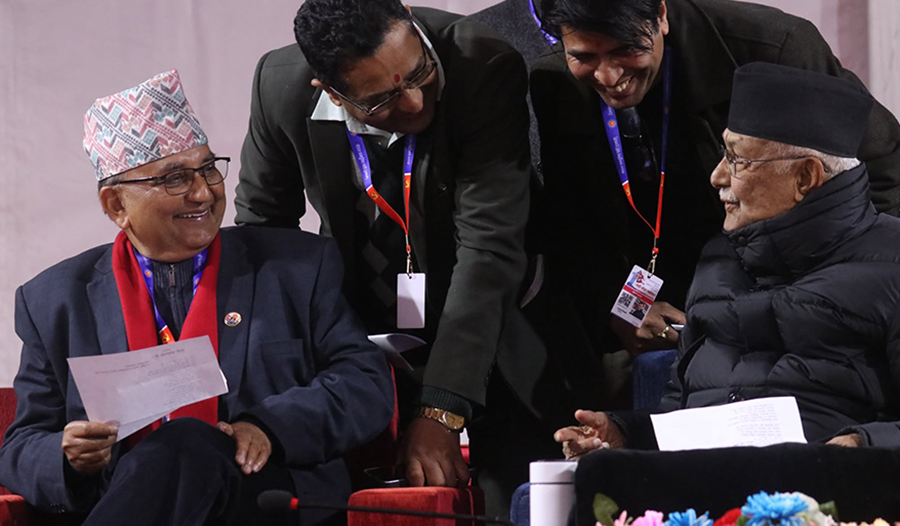
Kathmandu: The 11th General Convention of Nepal’s Communist Party (UML) is currently underway in Kathmandu’s Bhrikutimandap, where voting for new leadership is ongoing. As of December 18, 2025 (corresponding to Pus 3, 2082 in the Nepali calendar), the election process has revealed significant insights into the party’s internal dynamics. Based on interactions with over 100 delegates—including local representatives, geographical leaders, and provincial figures—four key scenarios or perspectives have emerged from the voters’ expressions. These reflect concerns about party unity, leadership balance, and future direction amid a competitive race between panels led by KP Sharma Oli and Ishwar Pokhrel. Below, I detail each scenario, drawing from voter sentiments, candidate strategies, and broader contextual factors.
1. Cross-Voting for Party Balance and Unity
One of the most prominent scenarios is the widespread practice of “cross-voting” (mat cross), where delegates are deliberately voting across panel lines to ensure a balanced leadership. This stems from a strong desire to keep the UML united and prevent dominance by a single faction.
- Voter Rationale: Many delegates expressed that while KP Sharma Oli remains the unchallenged choice for chairperson (with comments like “There’s no alternative to Oli for chairperson”), they are mixing votes for other positions to include candidates from both panels. This is seen as essential for “check and balance” within the party, especially given Oli’s reputation for a “harsh ruling style” that could sideline dissenters. One delegate noted, “If we don’t do this, it might create a situation where people can’t stay in the party.” Voters are using the candidate lists provided by both sides to selectively choose, leading to longer voting times—sometimes hours—due to the need for careful selection.
- Impact on Results: If this trend holds, it could lead to mixed outcomes beyond the chairperson position. Positions like vice-chairperson, general secretary, deputy general secretary, secretary, and even central committee members might see representatives from both factions. Oli’s panel is expected to dominate, but Pokhrel’s side is optimistic, claiming potential wins for at least 6-9 office-bearers based on the atmosphere and delegate feedback.
- Broader Context: This scenario highlights a shift from rigid panel loyalty, influenced by fears of internal fragmentation. Even Oli supporters acknowledge some cross-voting, though they downplay its decisiveness. Rajendra Rai, a supporter, insisted that “everyone will stick to the panel,” but the ground reality suggests otherwise, potentially resulting in a more inclusive central committee of 301 members elected by 2,263 delegates.
2. Intense Competition for the General Secretary Position
The second scenario revolves around the fierce rivalry for the general secretary role between Shankar Pokhrel (from Oli’s panel, seeking re-election) and Surendra Pandey (from Pokhrel’s group, stepping down from vice-chairperson to contest). Delegates view this as the tightest contest in the entire election, with potential for a razor-thin margin.
- Reasons for the Tight Race:
- Dissatisfaction with Shankar Pokhrel: Several leaders from provinces like Sudurpaschim, Madhesh, and Gandaki are unhappy with his alleged “unilateral” approach in selecting delegates and forming teams. Influential figures like Bishnu Paudel, Prithvi Subba Gurung, and Kiran Gurung have remained “silent,” withholding active support. Their influence could sway decisive votes toward Pandey.
- Vote Estimates: Oli’s side estimates 500-600 votes in their favor, but any cross-voting against Shankar could benefit Pandey. One delegate predicted a margin of as little as 50 votes, saying, “Listening to friends and the voting atmosphere, it doesn’t feel like more than a 50-vote difference.”
- Panel Loyalty vs. Reality: Oli supporters claim internal sabotage is unlikely since Shankar is on the chairperson’s panel, but Pokhrel’s camp sees an opening due to the discontent.
- Campaign Efforts: Ishwar Pokhrel (the panel leader) was actively campaigning throughout the day, greeting delegates in lines and leveraging personal relationships to secure votes. This hands-on approach underscores the high stakes for the general secretary role, which is pivotal for day-to-day party operations.
- Potential Outcome: A Pandey win could signal a broader dilution of Oli’s control, while a Shankar victory would reinforce the status quo. This contest exemplifies how personal grievances and regional dynamics are shaping the election.
3. Three Distinct Types of Delegates Influencing Voting Patterns
The third scenario identifies three categories of delegates, each with differing ideological and loyalty alignments, which are driving varied voting behaviors and potentially fragmenting results.
- Type 1: Ishwar Pokhrel’s Long-Time Associates: These are delegates who have coordinated with Pokhrel since his early political days. They are firmly in his camp, advocating for change and collective leadership.
- Type 2: Followers of Madan Bhandari’s Ideological Line: This group adheres to the foundational UML principles established by the late leader Madan Bhandari. They prioritize party unity and are mixing votes to include representatives from both factions, believing it’s necessary to keep the party “intact.”
- Type 3: Oli’s Post-Leadership Recruits: Delegates who joined or rose under Oli’s tenure since he took leadership. This group is described as “one-stamp voters,” loyal exclusively to Oli’s panel and uninterested in alternatives.
- Voting Implications: Types 1 and 2 share similar mindsets, often cross-voting for balance, while Type 3 remains rigidly partisan. One delegate explained, “The first and second streams are voting mixed to unite the party; the third sees only Oli.” This division could lead to unpredictable results, especially if the first two types dominate in key positions.
- Overall Effect: This segmentation reflects generational and ideological shifts within UML, amplified by recent external pressures like the Gen-Z movement, which has pushed parties toward internal reforms.
4. The Role of Neutral or Swing Votes in Altering Outcomes
The fourth scenario focuses on the influence of “neutral votes” (tatastha mat), estimated at 10-18% of the total, which could tip the scales in close races and lead to unexpected results.
- Uncertainty and Potential: Leaders acknowledge that these undecided or swing voters—possibly disillusioned or independent-minded—hold the power to “change the result.” However, their exact number is unclear, adding an element of unpredictability to the election.
- Connection to Broader Trends: This ties into the convention’s atmosphere, where voting via electronic machines has been time-consuming (e.g., Ishwar Pokhrel reported it took him 1 hour and 4 minutes due to clustered voting). Delegates’ enthusiasm for democratic processes is high, but the prolonged voting (starting Wednesday morning and continuing into Thursday) reflects careful deliberation, potentially amplifying neutral influences.
- Link to External Pressures: Political analyst Hari Sharma, in a separate discussion, attributes the UML’s internal churn to the Gen-Z movement’s impact. He views the convention’s urgency as a response to youth-led protests, forcing parties like UML, Congress, and Maoists to address generational shifts. Sharma warns against seeing the movement as a “conspiracy,” calling it an “explosion of long-simmering dissatisfaction” that has created “momentum” for change. This external “vibration” may encourage neutral voters to favor reform-oriented candidates, potentially leading to “cosmetic” or genuine transformations in leadership.
Overall Implications
These four scenarios paint a picture of a UML convention marked by tension between unity and competition, with cross-voting and neutral influences challenging Oli’s dominance. While Oli’s panel is favored to win overall, Pokhrel’s group anticipates gains, possibly securing 6-9 office-bearers. The electronic voting, ongoing as of early Thursday morning, involves 2,263 delegates electing 19 office-bearers and 301 central members. Results could reshape UML’s future, especially amid calls for “collective leadership” and adaptation to youth demands.
This detailed breakdown is based on direct voter interactions reported in the article, highlighting the party’s evolving internal democracy. For real-time updates, monitoring official UML announcements or related news is recommended.
प्रतिक्रिया