
 प्रदेश-१
 मधेस
मधेस बागमती
 गण्डकी
 लुम्बिनी
 कर्णाली
 सुदूरपश्चिम
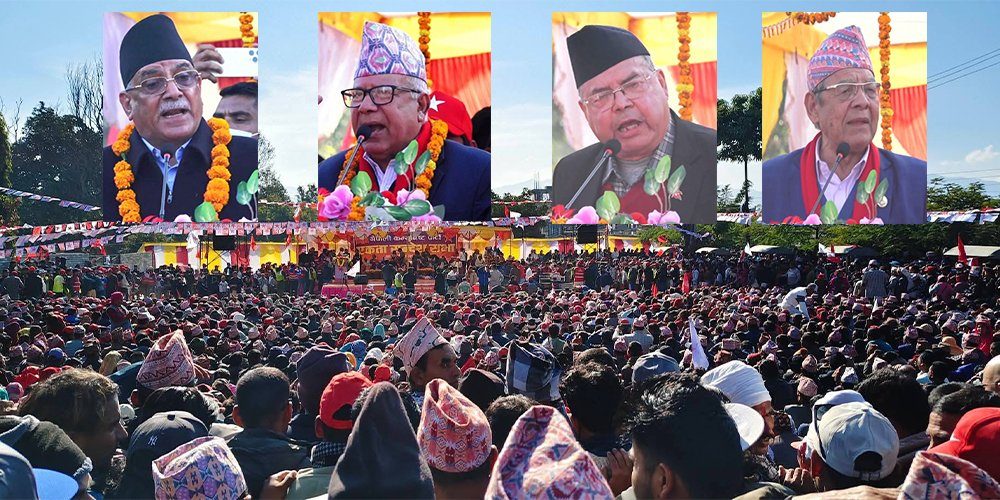
Slander Against Oli, Curses for Kulman, and ‘Socialism’ Lollipop for the People
Kathmandu Dec 14: On Saturday, the newly formed Nepali Communist Party (NCP) — born from the unification of the CPN (Maoist Centre), CPN (Unified Socialist), and several other communist factions — held its “Unity Message Assembly” in Birendranagar, the capital of Karnali Province.

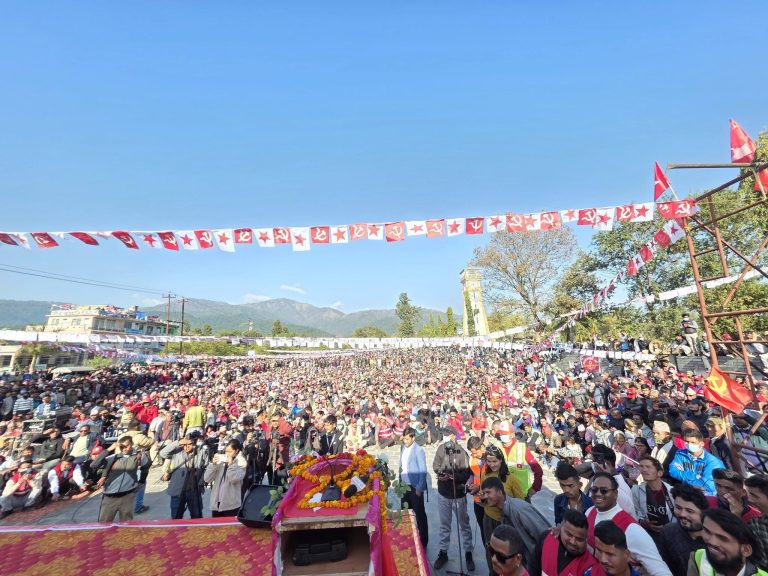
The event drew a thick and enthusiastic crowd of leaders, cadres, and ordinary citizens. Local organizers had been working tirelessly for two weeks to make it happen. Top leaders invested heavily to turn this Karnali rally into a historic showcase of unity.
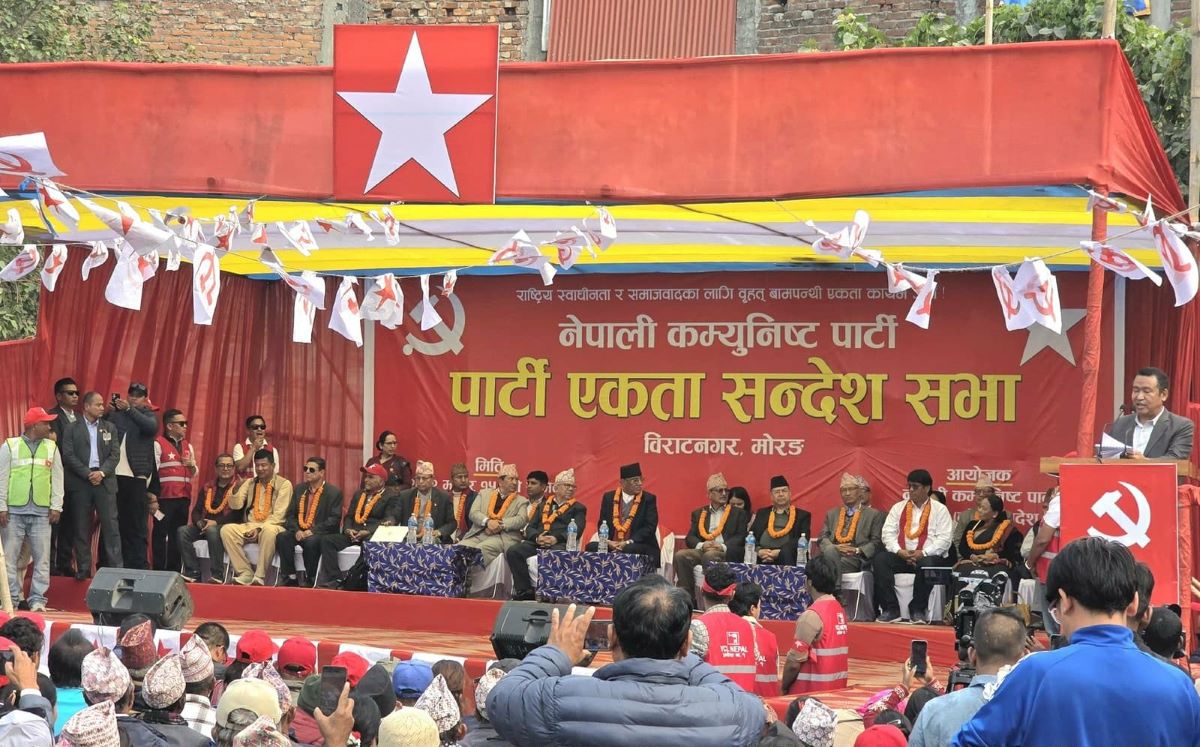
The real motivation was clear: influential Maoist leader and former deputy general secretary Janardan Sharma stayed out of the unification process and is preparing to form his own party. In a region once dominated by Sharma, proving the unified NCP’s strength without him became a matter of prestige for the leadership.
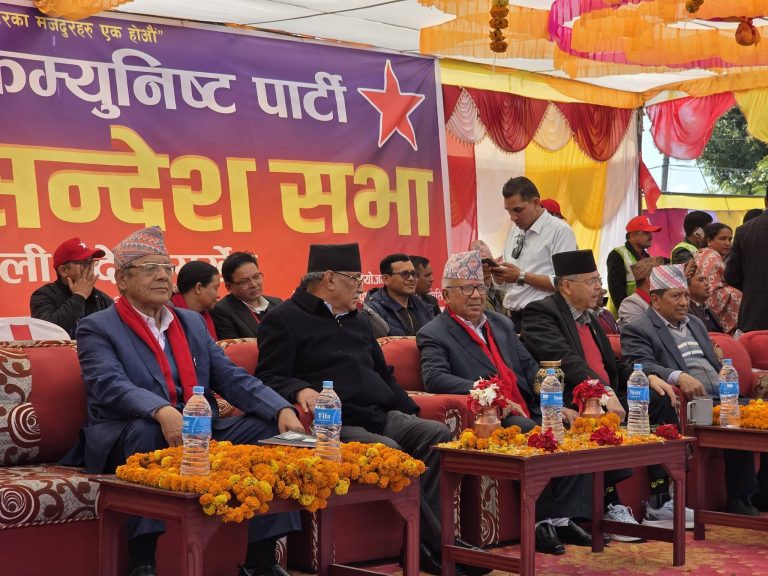
Following this strategy, buses were arranged to bring ordinary people from surrounding areas to the venue.
Thanks to the leaders’ relentless efforts, the attendance looked impressive. However, the top leaders on stage spent nearly five hours recycling their traditional, outdated speeches.
NCP Coordinator Pushpa Kamal Dahal Prachanda, along with Madhav Kumar Nepal, Jhalanath Khanal, Bamdev Gautam, Bhim Rawal, and others, devoted most of their addresses to criticizing rival parties — the CPN (UML) and Nepali Congress.
People expected a clear message about the post-unity party’s future direction, strategy, and goals. Ironically, instead of focusing there, the leaders wasted time defending their past and attacking others.
Prachanda, who spoke the longest (about 30 minutes), claimed alignment with the Gen Z movement’s ideas.
He spent considerable time arguing that recent street protests arose because of Congress and UML, not his side. He also lashed out aggressively at Kulman Ghising, whom he himself had appointed to the Nepal Electricity Authority.
While citing achievements from his time in power, Prachanda said: “We must remember the good work done under our leadership, and also review our shortcomings and limitations. We historically transformed a Nepal plagued by load-shedding into a load-shedding-free nation. No one can call that bad. But now Kulman has eaten some poison and is trying to poke holes in the very plate he ate from. I urge him not to do that — may his wisdom return.”
He sharply labeled his own appointee as “ungrateful” right from the stage.
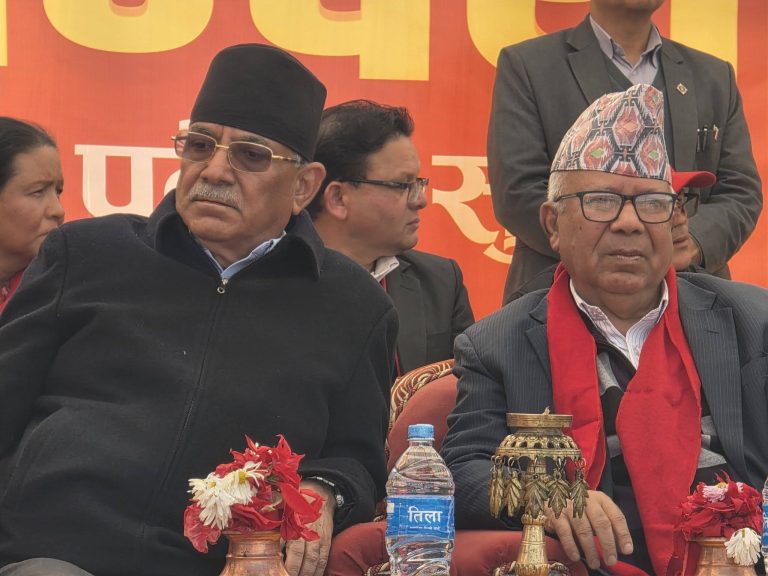
In the past, during the Maoist insurgency era, Prachanda would warmly address martyrs and wounded fighters in base areas. This time, that intimacy felt missing, according to one participant cadre.
A member of a martyr’s family complained: “It feels like he’s abandoned the Maoists altogether. Martyrs’ families and the wounded are just tools for his speeches — our problems remain unchanged.”
Prachanda expressed happiness at the crowd, signaling his strength hadn’t weakened. He recalled: “Seeing this gathering reminds me of when comrades from Karnali and Sudurpaschim urged immediate unity.”
He added that they had assured unity would make them the number one party in those provinces.
This was the final provincial unity message assembly outside Kathmandu (after starting in Sudurpaschim). The enthusiastic turnout energized him: “Looking at Dhanagadhi and Surkhet rallies, it’s not just about becoming number one — you’ve sent a strong message that we can rewrite history here and start a socialist revolution.”
He repeats similar promises every visit to Karnali, yet complaints persist about the leadership’s lack of strategic role in the region’s development. Even after provincial governments formed, Maoists stayed in power continuously, but electoral data shows their vote share declining steadily.
NCP insiders admit Karnali is no longer a Maoist “fortress” as in the war days. Cadres accuse post-peace process leaders of forgetting martyrs, wounded families, and indulging in wealth.
One former combatant shared frustration: “Yesterday, blood shed anywhere was said to be Karnali’s — the region fueled the war. Now leaders have ditched Maoism; the party is decaying and splintering.”
He added: “We needed internal unity as much as possible. Our former commanders aren’t here today; those who spewed venom against us yesterday are now alongside.”
Prachanda claimed restarting the fight against corruption, describing Karnali’s nature and resources traditionally — but offered no concrete example of visible work he did for the province.
He asserted Gen Z activists are joining NCP and their demands align with his party. To please stage guests Madhav, Bamdev, and Bhim Rawal, he reminisced about past collaborations.
He recalled a historic document from the people’s war era signed between Maoists (by him) and then-UML (by Bamdev), laying groundwork for the 12-point understanding.
Thus, he argued this unity isn’t sudden — it’s built on decades of debates, disagreements, collaborations, and reviews involving dozens of communist/socialist groups.
Prachanda spent much time reviewing history but didn’t mention key war commander Janardan Sharma .
Co-coordinator Madhav Kumar Nepal briefly complained that opponents spread propaganda claiming “they did nothing” despite his side’s good past work. He promised the new party would belong to honest people.
“Without ending corruption and selfish tendencies, we can’t prosper the country,” he said. “That’s why we united, admitting past weaknesses and committing to honest work.”
Former Prime Minister Jhalanath Khanal urged UML to join the unity and socialist path, telling UML ranks: “Come, let’s advance on the same road as one communist force.”
Socialism Discussions and Pledge for a Graft-Free Party
While Prachanda and Madhav Nepal avoided detailing future directions, Khanal and Bamdev Gautam repeatedly invoked “socialism.”
Khanal stressed Nepali-characteristic socialism (not foreign models) as NCP’s goal: “Ending capitalism and corruption requires all communists uniting for socialism — no alternative.”
He noted failures in transforming education and health: “Socialism is essential for all to access food, shelter, clothing, and education easily.”
Bamdev Gautam declared socialism the only path forward, daring the crowd: “If we fail to build socialism, lock us in jail — we have no escape now.”
Initially upset by lack of applause, he grew aggressive: “Don’t just say ‘socialism, socialism’ to deceive people.”
He claimed 300,000 attendees.
Narayan Kaji Shrestha pledged to make NCP a party of non-grafters: “We must unite all who reject corruption.”
He claimed Maoist governments prioritized good governance, but Congress and UML disliked it — leading to the Gen Z movement.
Aggressive Toward Oli
Like Prachanda and Madhav Nepal, Bamdev Gautam blamed Oli for the Gen Z protests.
Bhim Rawal spent most of his time attacking Oli: “Oli should be ashamed to call himself a national leader — fleeing when the country burns?”
He questioned Oli’s suppression instead of addressing Gen Z demands: “Our young voices made KP ji flee — shameful. Even now, claiming power doesn’t suit him.”
Rawal raised burning Karnali issues like the deplorable Karnali Highway, untapped potential of apples, yarsagumba, and herbs.
He sharply criticized Indian company GMR over the Upper Karnali hydropower project.
Odd Claim of Becoming Karnali’s Top Party
Post-federalism, Maoists never became Karnali’s top party or contested alone. With Congress and UML strengthening, NCP leader Prakash Jwala oddly claimed NCP would top upcoming elections in Karnali.
Known for floor-crossing against his own party (then UML) in Karnali politics and later joining Unified Socialist for central/ministerial perks (despite weak base there), Jwala enthused: “Stars will rise in Karnali next election. It will be NCP’s red fortress — the province to sound rebellion and revolution’s bugle.”
Shakti Basnet echoed similar sentiments briefly.
The rally showed strong mobilization but highlighted persistent gaps between leaders’ rhetoric and ground realities — old attacks, vague socialism promises, and little fresh vision for post-Gen Z Nepal.
प्रतिक्रिया