
 प्रदेश-१
 मधेस
मधेस बागमती
 गण्डकी
 लुम्बिनी
 कर्णाली
 सुदूरपश्चिम
NP-Comment: Kathmandu Nov 9: The CPN (UML) is on the verge of its 11th General Convention. The UML is holding its third General Convention in Kathmandu on December 12, 13, and 14 (Mangsir 27, 28, and 29 BS).
As the date of the convention approaches, polarization within the UML is increasing. The debate over policy and leadership is intensifying.
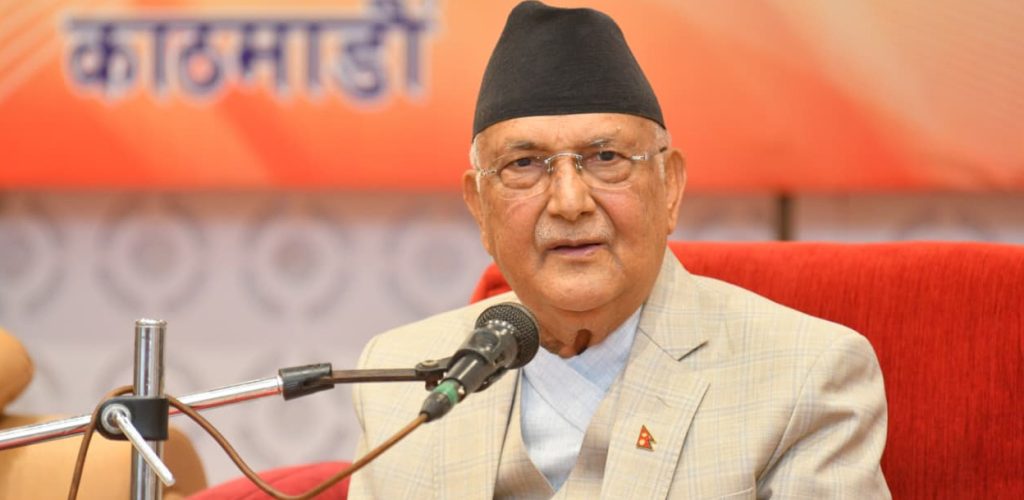
However, UML Chairman KP Sharma Oli does not want any debate on policy or leadership. Last Friday, at a seminar organized by the party’s Central Education and Human Resources Department for the intelligentsia, Chairman Oli stated that there would be no discussion at this General Convention.
His comment—that the convention will conclude after his directive speech and the party will then focus on the movement for the restoration of the dissolved House of Representatives—has sent ripples through the UML ranks. An earthquake has struck within the UML.
“This time, I will be addressing the General Convention unilaterally. My inaugural speech will come, and that’s it. There will be no discussion on that either,” Oli said. “Right now, the dissolved House of Representatives must be reinstated. After that, we can comfortably work on policy formulation and implementation. The main task now is the restoration of the dissolved House of Representatives. This is the core issue of national politics. This is where the achievement must be made. This is the point where effort must be focused. We will emphasize this now.”
Chairman Oli claimed that the General Convention had to be moved a year earlier because some leaders caused a disturbance by raising the issue of leadership selection and party reorganization.
By statute, the term of the UML’s current leadership is until December 2026 (Mangsir 2083 BS). The UML’s constitutional provision states that the General Convention must be held every five years. The 10th General Convention was held in Chitwan from November 26 to 30, 2021 (Mangsir 10 to 14, 2078 BS).
“You must have heard that some comrades raised the issue of leadership selection. We brought the convention forward, which could have been held a year later, because one group of comrades made a big noise, demanding party reorganization and causing indiscipline,” he stated.
Following Oli’s statement prohibiting debate at the General Convention, we spoke to several office bearers about the matter. Some formally objected, while others informally expressed dissatisfaction.
Vice-Chair Asta Lakshmi Shakya said that saying there will be no debate at the General Convention is not even worth commenting on. She added that such a statement coming from the Chairman’s level is a serious matter.
“Chairman Oli has a series of actions aimed at undermining the party’s procedures and ideology. We have been strongly opposing this. The General Convention itself is a venue for debate,” she said. “We will not accept any attempt to push the party backward from its principles and procedures.”
Arguing that an arrogance has developed in Chairman Oli where he listens to no one’s opinion but his own, she asserted that this is the reason for the weakening of the party and the political system.
“It is terrifying when arrogance emerges in the leadership, and that ideology seeks to govern others; this will not give momentum to the UML,” she said. “If there is no discussion on questions of procedure, ideology, and leadership, and if debate is not accepted, then why hold the General Convention? He could just appoint [the leaders] himself!”
Shakya further alleged that since Chairman Oli has already deviated from procedure and ideology, others’ opinions are not acceptable to him. She insisted that despite Chairman Oli’s wishes, there will be an intensive discussion on policy and leadership at this convention.
“The party’s policy was discussed and a conclusion was reached at the Statute Convention. But if there were any shortcomings in the context of the September 8 and 9 (Bhadra 23 and 24) movement or the perspective we adopted, that too will be discussed,” she said. “Even if the Chairman says there will be no debate, I see the possibility of even more intensive discussion at this General Convention. What all does he say? He is even claiming that he made me Vice-Chair and Secretary. Did he choose me? Wasn’t I elected by the delegates’ votes at the General Convention? He makes such remarks!”
Oli’s Close Associates Say: Oli is Following the Stalin Path
During the ninth meeting of the UML’s Central Committee, Chairman Oli faced the accusation of being a Stalinist.
In that meeting, Chairman Oli proposed approving the decision to suspend the renewed membership of former President Bidya Devi Bhandari. While Oli’s supporters were applauding, Vice-Chair Surendra Pandey countered. At that time, Vice-Chair Pandey said that Oli was trying to run the party in the style of Stalin.
“You are trying to create a Stalin-like party, where Communist parties would tremble as soon as Stalin’s boot struck,” Pandey said. Oli not only immediately counter-argued but demanded an apology and had the proposal rejected from the floor. Central Committee members supporting Oli applauded loudly.
Now, Oli’s latest comment—that the General Convention will conclude after his directive speech—is being interpreted by office bearers close to him as the ‘hangover of the Stalin path.’
Citing the example that even the former Russian Communist leader Lenin respected the Central Committee’s decisions, they pointed out that an UML Chairman—a party known for its democratic internal life—saying he will not allow speaking or debate at the General Convention is a dictatorial trait.
“Even Lenin held discussions in the party. He gave ample space for debate. Lenin himself was in the minority at times. When he was in the minority, he adhered to the party decisions,” the official said. “Chairman Oli is not facilitating debate and discussion in the party committee; instead, he is making statements that remove the General Convention, the venue for debate, from discussion, claiming the convention ends after he speaks.”
It is worth noting that Chairman Oli himself had raised the issue of the democratization of party life during the Seventh (Janakpur) General Convention. His conclusion was that the core essence of the Multi-Party People’s Democracy (Janatako Bahudaliya Janabaad – Jabaj) work directive, passed by the Fifth General Convention, was the democratization of party life. Jabaj considers competition the key element in leadership and idea formation. Achieving excellence through competition is the core characteristic of Jabaj.
Claiming to further enrich and refine the Jabaj work directive, Chairman Oli introduced age limits and term limits for leadership. The essence of the democratization of party life championed by Oli was the idea that authoritarian tendencies arise when the same person repeats as leader, and therefore, a 70-year age limit and a maximum of two terms for election should be adopted.
As a result of the debate raised by Oli, the UML shifted to a collective leadership system following its Eighth General Convention.
The party adopted a multi-post structure at the convention held in Butwal in February 2009 (Falgun 2065 BS). The Ninth General Convention in 2014 established the 70-year age limit and term limit provision. Although the Statute Convention held before the Tenth General Convention accepted both provisions, the term limit provision was later removed during the closed session in Sauraha.
Subsequently, the 70-year age limit was suspended by the Secretariat meeting itself. Although the age limit set by the Statute Convention was suspended to ease the entry of leaders coming from the erstwhile Unified Socialist party, the second Statute Convention did not include any provision to continue it.
“Chairman Oli’s statement that the General Convention—the venue for debate and ideas—will not allow speaking suggests that he is advancing on the ‘Stalin path‘. Recent events confirm he is becoming autocratic,” the official said. “Oli’s statement raises the question of whether our commitment to democracy itself is being weakened. This will not only make party life difficult but also weaken the country’s democracy.”
That same official suggested that if the party is not going to hold debate and deliberation at the General Convention, Oli should issue an order directly from Gundu, Bhaktapur (his residence).
“The Communist Party is not like the King’s Hukum Pramangi (Royal Decree)! Here, there must be a comprehensive debate on policy and leadership; only then do we reach a conclusion,” the leader asserted.
Following Chairman Oli’s statement prohibiting debate at the General Convention, its effect has already begun to trickle down. The UML Dolakha District Committee decided that Oli should be retained as Chairman even after the 11th General Convention.
The official remarked that while the District In-charge and leadership might wish for a specific person to win, making a decision about the overall jurisdiction of the General Convention is ridiculous.
“When the Chairman demonstrates an autocratic character by saying he won’t allow speaking, the District Committees emulate him. It’s not just Dolakha; other districts favorable to the leadership might also make such a decision,” the leader said. “It is precisely to stop this kind of tendency that we must develop democratic values, systems, and traditions within the party.”
प्रतिक्रिया